
Electric Unicycle vs Electric Scooter: Specs, Size and Price Compared
Affiliate disclosure: product links on this page go to Amazon, or to the maker's own store for brands that sell only direct. As an Amazon Associate we earn from qualifying purchases, at no extra cost to you; a link to a maker's store earns us nothing. No retailer or brand sees our picks before they are published or has any say in them. How we choose.
An electric scooter is easier to start on: you hold handlebars and ride away, with no balancing to learn. An electric unicycle carries more battery for the money and takes up far less space. Segway's Ninebot Max G2 scooter (551 Wh, 20 mph by default, 53.5 lb) folds to 47.6 inches long. InMotion's V9 electric unicycle (750 Wh, 28 mph, 50.7 lb, $799 on sale) stands 24.9 inches tall and 7.4 inches wide, and King Song's 14D Pro weighs 32 lb.
Choose the scooter if you want to commute next week with little practice. Choose an electric unicycle if storage space, carrying it onto a train or under a desk, and battery per dollar matter more, and you will put in the practice. Figures come from Segway's, InMotion's and King Song's own product pages and manuals, read on October 9, 2026.
Side by side on the makers' specs
| Spec | Segway Max G2 (scooter) | InMotion V9 | King Song 14D Pro | King Song 16S Pro |
|---|---|---|---|---|
| Price band | $600 to $650 (Amazon) | $800 to $1,300 | $730 to $1,000 | $1,150 to $1,600 |
| Battery | 36V, 551 Wh | 84V, 750 Wh | 60V, 420 Wh | 840 Wh |
| Motor (rated / max) | 450 W / 1,000 W | 1,000 W / 2,000 W | 800 W / 2,400 W | 1,200 W / 3,800 W |
| Top speed | 20 mph default; 22 mph unlocked in the app | 28 mph | 18.6 mph | 22 mph |
| Range (maker) | 43 mi theoretical; 25 to 28 mi at top speed | 37 mi; 20 to 30 typical | Up to 25 mi | 45 mi |
| Weight | 53.5 lb | 50.7 lb | 32 lb | 38.4 lb |
| Size | 47.6 x 22.4 x 23.8 in folded | 18.8 x 7.4 x 24.9 in | Not listed | 18.2 x 9.3 x 19.9 in |
| Tires | 10 in tubeless, self-sealing | 16 x 3 in tubeless | 14 in | 16 x 2.125 in |
| Suspension | Front hydraulic, rear spring | 60 mm | None | None |
| Water rating | IPX5 | IPX6 | IPX5 | IP54 |
| Max rider | 265 lb | 265 lb | 265 lb | 265 lb |
| Charge time | About 5 h | 5 h | About 3.5 h | About 7 h (2 A charger) |
Price bands for the electric unicycles run from the maker's sale price to its regular price; the scooter's band is around the Amazon price seen on October 9, 2026, and prices change often. Segway's range note is unusually honest: its page gives the 43-mile "theoretical" figure and, separately, 28 miles at 20 mph and 25 miles at 22 mph.
Learning curve and control
This is the scooter's biggest advantage. A scooter has handlebars with the throttle and brake controls on them, and Segway lists traction control (TCS anti-skid) on the Max G2. An electric unicycle has none of that: you balance on two pedals, speed up by leaning forward, and, in InMotion's words, "to brake, shift your weight backward or lower your body."
The learning time is shorter than many expect. InMotion's FAQ says most people learn the basics within the first hour, and King Song's beginner guide plans the first session as 10 to 20 minute blocks. InMotion's V12S manual asks for an open, flat area of at least 4 by 4 meters, a skilled assistant, and a helmet and protective gear. Budget a few sessions in an empty lot before you ride anywhere with traffic; our Onewheel comparison covers how the other balance-based option differs.
Size, weight and storage
Folded, the Max G2 is 47.6 inches long and 23.8 inches tall. The V9 stands 24.9 inches tall in a footprint of 18.8 by 7.4 inches, and the 16S Pro is 19.9 inches tall. That difference decides whether the vehicle fits under a desk, in a small car trunk or beside you on a crowded train.
Weight is closer than size. The V9 (50.7 lb) and Max G2 (53.5 lb) are within 3 lb of each other, while the 14D Pro is 21.5 lb lighter than the scooter and the 16S Pro 15.1 lb lighter. Many electric unicycles have a trolley handle so you can roll them like luggage.
Range, battery and charging
At similar prices, the electric unicycles carry more battery: the V9's 750 Wh is 199 Wh more than the Max G2's 551 Wh, and the 16S Pro's 840 Wh is 289 Wh more. Range claims are harder to compare because the conditions differ. InMotion's V12S manual defines its typical range at a 90 kg (198 lb) load, 25°C (77°F) and 20 to 40 km/h (12 to 25 mph) on a flat paved road, while most product pages, including the V9's, give no conditions. Work your own trip out with the range calculator.
Charging is similar at the low end: about 5 hours for the Max G2 and the V9, about 3.5 hours for the 14D Pro's smaller pack, and about 7 hours for the 16S Pro on its stock 2 A charger.
Ride comfort, hills and weather
The Max G2 pairs 10-inch tubeless self-sealing tires with front hydraulic and rear spring suspension, and Segway rates it for most flat roads and cobblestones, with a 22% maximum slope. The electric unicycles roll on larger 14 to 16-inch tires; the V9 adds 60 mm of suspension and InMotion lists a 30° hill-climb angle, while King Song lists 32° for the 14D Pro. Treat all climbing figures as maker maximums, not what a heavy rider will manage on a long hill.
For rain, the ratings are similar: IPX5 on the Max G2 and 14D Pro, IPX6 on the V9 and IP54 on the 16S Pro. Segway's own FAQ says its scooters can handle light rain but should not be submerged, King Song's pages say its wheels are not waterproof, and InMotion and King Song (in its warranty policy) both exclude water damage.
Certification and where you can ride
Segway's Max G2 page says the scooter was tested and certified by TÜV Rheinland to the UL 2272 standard, and King Song lists UL 2272 for the 14D Pro and 16S Pro. Rules on where each may be ridden vary by state and city, and the two vehicles do not always fall under the same rules; check yours in our guide to where electric unicycles are legal before you buy. The CPSC's advice applies to both: wear a bicycle helmet every ride, and charge with the maker's charger while you are home and awake.
Who should buy which
Buy a scooter like the Max G2 if you want the shortest path from box to commute, prefer handlebar controls, and have room to store a 47.6-inch folded frame. Buy an electric unicycle if you need to carry or stow it in small spaces, want more battery at a similar price, or want the lighter weight of a 14-inch wheel like the 14D Pro, and you will practice first. For specific commuter picks, see our best electric unicycles for commuting and the InMotion line-up.
Frequently asked questions
Is an electric unicycle harder to learn than an electric scooter?
Yes, at the start: a scooter is steered and braked from its handlebars, while an electric unicycle is balanced and braked with your body. InMotion's FAQ says most people learn the basics within the first hour, and its manual recommends practicing in an open area at least 4 by 4 meters with an assistant and full protective gear.
Which is more portable, an electric unicycle or a scooter?
On size, the electric unicycle. Segway's Max G2 folds to 47.6 inches long, while InMotion's V9 stands 24.9 inches tall on an 18.8 by 7.4 inch footprint. On weight the V9 and Max G2 are close (50.7 and 53.5 lb), but smaller wheels such as King Song's 14D Pro weigh 32 lb.
Which has more range for the money?
On published figures, the electric unicycle carries more battery at a similar price: 750 Wh in the $799 InMotion V9 against 551 Wh in the Segway Max G2, which sat in a $600 to $650 band on Amazon when we checked in October 2026. Segway rates the Max G2 at 25 to 28 miles at top speed; InMotion calls 20 to 30 miles typical for the V9.
Can an electric unicycle replace a scooter for commuting?
On the specs, yes: the V9 and 16S Pro match or beat the Max G2 on battery and speed, with similar 265 lb rider limits and water ratings. The differences are the learning period, carrying the wheel instead of folding a frame, and braking with your body instead of a lever.
Are electric scooters and electric unicycles UL 2272 certified?
Some are. Segway says the Max G2 was tested and certified by TUV Rheinland to UL 2272, and King Song lists UL 2272 for the 14D Pro and 16S Pro. Certification is model by model, so check the maker's page or ask for the certificate before you buy.
Which is better in the rain, an electric unicycle or a scooter?
Neither is waterproof. The Max G2 and King Song 14D Pro are rated IPX5, the InMotion V9 IPX6 and the King Song 16S Pro IP54. Segway says its scooters handle light rain but should not be submerged, and InMotion and King Song both exclude water damage from their warranties.
Sources
- Segway Ninebot KickScooter Max G2, Segway
- INMOTION V9, INMOTION
- KingSong 14D Pro, KingSong
- KingSong 16S Pro, KingSong
- How to ride an electric unicycle?, INMOTION
- FAQs, INMOTION
- INMOTION V12S Electric Unicycle User Manual, INMOTION
- Learn to Ride an EUC, KingSong
- Warranty Policy, INMOTION
- Micromobility: E-Bikes, E-Scooters and Hoverboards, U.S. Consumer Product Safety Commission
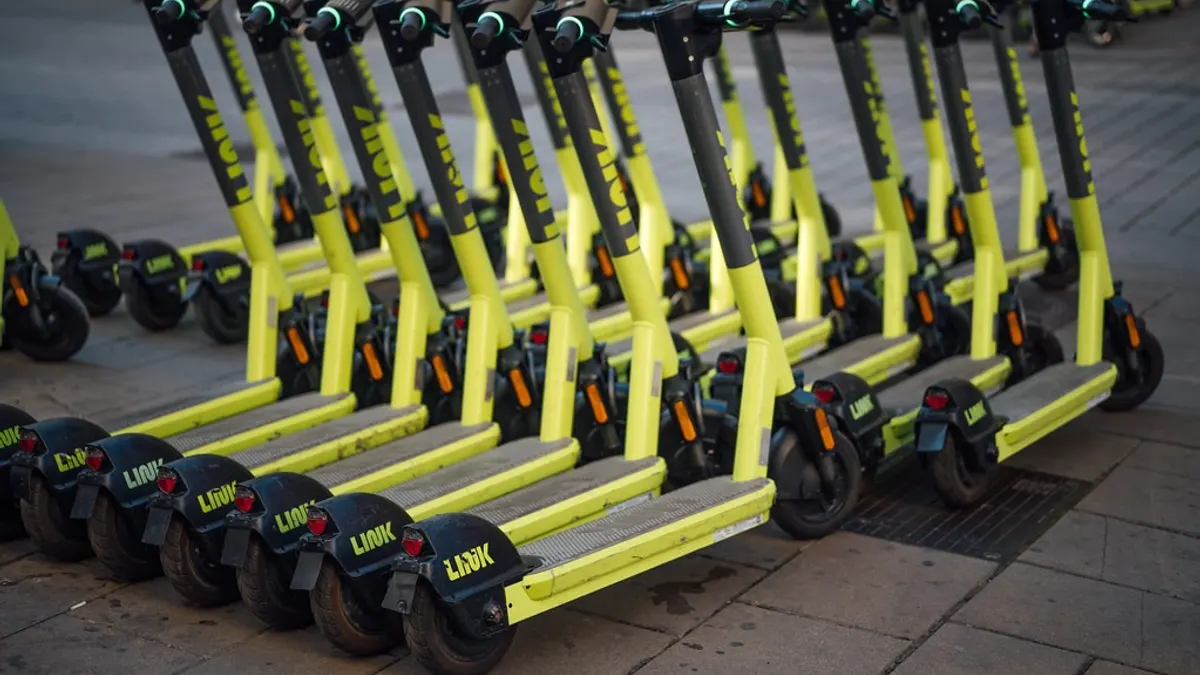
Cover photo: Electric scooters sharing by Link. E-Scooters parked on the sidewalk by Ivan Radic, CC BY 2.0, via Flickr. Cropped.
Related guides

Begode Electric Unicycle Lineup (2026): Every Model on Begode's Store
Eleven Begode wheels, all marked sold out on Begode's own store: what each one is, what Begode publishes, and how its warranty works.
Electric Unicycle Specs Compared (2026): Every Current Model in One Table
A sortable spec table for every current wheel from the four main makers: battery watt-hours, top speed as listed, weight, motor, tire and suspension.
Electric Unicycle vs Onewheel: Range, Speed, Weight and Price Compared
At the same money, an electric unicycle goes farther and faster; a Onewheel is lighter and rides like a board. The numbers, side by side.