
Electric Unicycle Battery Voltage Explained: 84V to 151V, Wh and Ah
Affiliate disclosure: product links on this page go to Amazon, or to the maker's own store for brands that sell only direct. As an Amazon Associate we earn from qualifying purchases, at no extra cost to you; a link to a maker's store earns us nothing. No retailer or brand sees our picks before they are published or has any say in them. How we choose.
An electric unicycle's voltage is its battery's voltage at full charge, and it tells you how many lithium-ion cells are wired in series. Each cell charges to 4.2V, so an 84V wheel has 20 cells in series, 100.8V has 24, 134.4V has 32 and 151.2V has 36. Voltage sets how much power headroom the motor has; watt-hours, not volts, set how far the wheel goes. More of either means more cells, and more cells mean a heavier wheel.
Where the numbers come from
The makers' own spec sheets show the arithmetic. InMotion lists the V9's pack as 20S2P (20 cells in series, 2 in parallel) with an 84V charger: 84 divided by 20 is 4.2V per cell at full charge. Its V14 Pro is 32S4P at 134.4V, again 4.2V per cell. King Song's F18 has 144 cells and a 151.2V maximum charging voltage, which is 36 cells in series (151.2 divided by 4.2) and, by our arithmetic, four in parallel.
A cell's nominal voltage, its average over a discharge, is lower. Molicel rates its 21700-size P45B cell at 3.6V nominal. Makers round this differently: King Song lists the 84V 18XL Pro at 72V nominal (3.6V per cell for 20 cells) but the 151.2V F18 at 133.2V nominal (3.7V per cell for 36). Either way, the full-charge figure is the one in the name.
The voltage classes
| Class (full charge) | Cells in series | Nominal at 3.6V per cell | Examples |
|---|---|---|---|
| 54.6V | 13 | 46.8V | InMotion E20 (13S2P, 54.8V charger listed) |
| 67.2V | 16 | 57.6V | King Song 16S Pro (67.2V charger) |
| 84V | 20 | 72V | InMotion V9, King Song 18XL Pro (72V nominal) |
| 100.8V | 24 | 86.4V | InMotion V12 Pro (24S2P, sold out when we checked) |
| 126V | 30 | 108V | No current InMotion or King Song page we read states this class (King Song lists no voltage for the S18 Pro+ or S19 Pro) |
| 134.4V | 32 | 115.2V | InMotion V14 Pro (32S4P) |
| 151.2V | 36 | 129.6V (King Song states 133.2V) | King Song F18 |
| 168V | 40 | 144V | Begode Blitz Pro 168v and X-Way 168v (named on Begode's store) |
Two notes on the table. The cell counts for the 54.6V to 151.2V rows follow from 4.2V per cell; where a maker states the series count (the V9, V12 Pro, V14 Pro and E20), it matches. The 168V row is our arithmetic from Begode's product names; Begode's store page did not give cell counts. InMotion's E20 page also lists a "26V" battery voltage, which does not fit a 13-cell pack charged at 54.8V, so we go by the cell layout and charger.
Watt-hours vs amp-hours
Watt-hours measure energy, and energy is what sets range. Amp-hours measure charge at a given voltage, so they only compare fairly between packs of the same voltage. To convert, multiply amp-hours by nominal voltage:
- Watt-hours = amp-hours x nominal volts.
- Amp-hours = watt-hours / nominal volts.
Worked example: the V9's 750 Wh at 72V nominal is about 10.4 Ah. A wheel listed as 20 Ah at 72V would be 1,440 Wh, while 20 Ah at 129.6V would be about 2,592 Wh, nearly double the energy for the same amp-hour figure. That is why spec sheets in Ah can mislead across voltage classes, and why our range calculator takes watt-hours.
Cell-level arithmetic works the same way. A Molicel P45B cell is rated 4.5 Ah at 3.6V nominal, or 16.2 Wh. A hypothetical 20S4P pack of those cells (80 cells) would hold 80 x 16.2 = 1,296 Wh.
Why higher voltage gives more headroom
Electrical power is volts times amps. A controller can only push so much current (InMotion quotes 180A for the V9's controller), so at the same current, more voltage means more power: 151.2V is 1.8 times 84V. That is why high-voltage packs sit on the most powerful wheels in each line-up: King Song's 151.2V F18 is rated at 5,000W, InMotion's 84V V9 at 1,000W.
Voltage also falls as a battery drains, from 4.2V per cell at full toward and below the 3.6V nominal. Less voltage means less headroom, which is why wheels get more cautious on a low battery. King Song's 16S Pro FAQ lists "low-battery alerts, current limiting, forced deceleration, and pedal tilt-back" among its protections and warns that low battery "does not mean the wheel should be pushed harder."
Why a bigger pack means a heavier wheel
Every extra volt or watt-hour is more cells. The makers' own figures show weight rising with cell count:
| Wheel | Pack layout | Cells | Battery | Weight |
|---|---|---|---|---|
| InMotion E20 | 13S2P | 26 | 240 Wh | 30 lb |
| InMotion V9 | 20S2P | 40 | 750 Wh | 50.7 lb (spec table) |
| InMotion V14 Pro | 32S4P | 128 | 2,400 Wh | 86 lb |
| King Song F18 | 144 cells (36 in series) | 144 | 2,664 Wh | 90 lb |
Motors, suspension and shells add to these totals, so cells are not the whole story, but no wheel gets a big pack without the weight that comes with it. Choose the smallest pack that covers your riding with a margin.
Voltage and charging
A charger must match the pack: an 84V wheel needs a charger whose output is 84V, a 151.2V wheel one that outputs 151.2V. King Song's 16S Pro uses a 67.2V charger; InMotion's V9 an 84V one. Never use a charger made for a different voltage class. The CPSC tells consumers to use only the charger provided with a micromobility device and not to use "universal" chargers unless they have been tested and approved for that device.
Voltage also converts watt-hours to the amp-hours a charger works in. Our charging time calculator does that step for each pack class, and our guide to battery safety and UL 2272 covers charging and storage habits.
How to read the battery line on a spec sheet
- Find the watt-hours. If only amp-hours are given, multiply by the nominal voltage.
- Find the full-charge voltage or the charger's output voltage, and divide by 4.2 to get the cells in series.
- Before comparing amp-hours between makers, check whether the nominal figure assumes 3.6V or 3.7V per cell.
- Note the cell maker and layout where given (InMotion lists layouts such as 20S2P; King Song names the cell model, such as Samsung 50S on the F18).
- Note the charger's output current; with watt-hours and voltage, it sets the charging time.
Which voltage should you buy?
- Learning and short trips: the 13S to 16S packs on trainers and small wheels are plenty.
- Commuting: 84V wheels such as the V9 and 18XL Pro cover most commutes.
- Trails and experienced riders: 134.4V and 151.2V wheels like the V14 Pro and F18 add headroom and weight in equal measure.
Our buying guide puts voltage alongside the other specs that matter.
Frequently asked questions
What does 84V mean on an electric unicycle?
It is the battery's voltage at full charge. Lithium-ion cells charge to 4.2V each, so 84V means 20 cells in series; InMotion's V9, for example, lists a 20S2P pack and an 84V charger. The nominal voltage of an 84V pack is about 72V, which King Song lists for its 18XL Pro.
Is a higher-voltage electric unicycle better?
Not for everyone. Higher voltage gives the motor more power headroom, since power is volts times amps, but it needs more cells in series, which means bigger, heavier and more expensive packs. An 84V wheel suits most commuters; 134.4V and 151.2V wheels are for experienced riders who want the extra headroom.
How do I convert amp-hours to watt-hours?
Multiply amp-hours by the pack's nominal voltage. A 20 Ah pack at 72V nominal (an 84V wheel) holds 1,440 Wh, and a 20 Ah pack at 129.6V nominal (a 151.2V wheel) holds about 2,592 Wh. Compare wheels on watt-hours, because amp-hours mean different amounts of energy at different voltages.
Why is nominal voltage lower than the voltage in the name?
The name uses the full-charge voltage, 4.2V per cell. Nominal voltage is the average over a discharge, which cell makers such as Molicel rate at 3.6V per cell. King Song lists 72V nominal for its 84V 18XL Pro and 133.2V nominal for its 151.2V F18.
Can I use a different charger on my electric unicycle?
Only one the wheel's maker approves, with the same output voltage as the pack. The CPSC warns against chargers marketed as universal for micromobility devices unless they have been tested and approved for the specific device, and tells consumers to use the charger provided.
Why does my electric unicycle feel weaker on a low battery?
Pack voltage falls as the battery drains, and lower voltage means less power headroom. Makers respond with protections: King Song's 16S Pro FAQ lists low-battery alerts, current limiting, forced deceleration and pedal tilt-back. Slow down and charge rather than pushing on.
Sources
- INMOTION V9 Electric Unicycle, INMOTION
- INMOTION V14 PRO Electric Unicycle, INMOTION
- KingSong F18 Electric Unicycle, KingSong
- KingSong 18XL Pro Electric Unicycle, KingSong
- INMOTION E20 Electric Unicycle, INMOTION
- KingSong 16S Pro Electric Unicycle, KingSong
- INMOTION V12 Pro Electric Unicycle, INMOTION
- INR-21700-P45B (Low impedance), Molicel
- Begode EUC Lineup, Begode
- CPSC Urges Consumers to Not Buy or Use "Universal" Chargers with Micromobility Products Due to Fire Hazard, U.S. Consumer Product Safety Commission
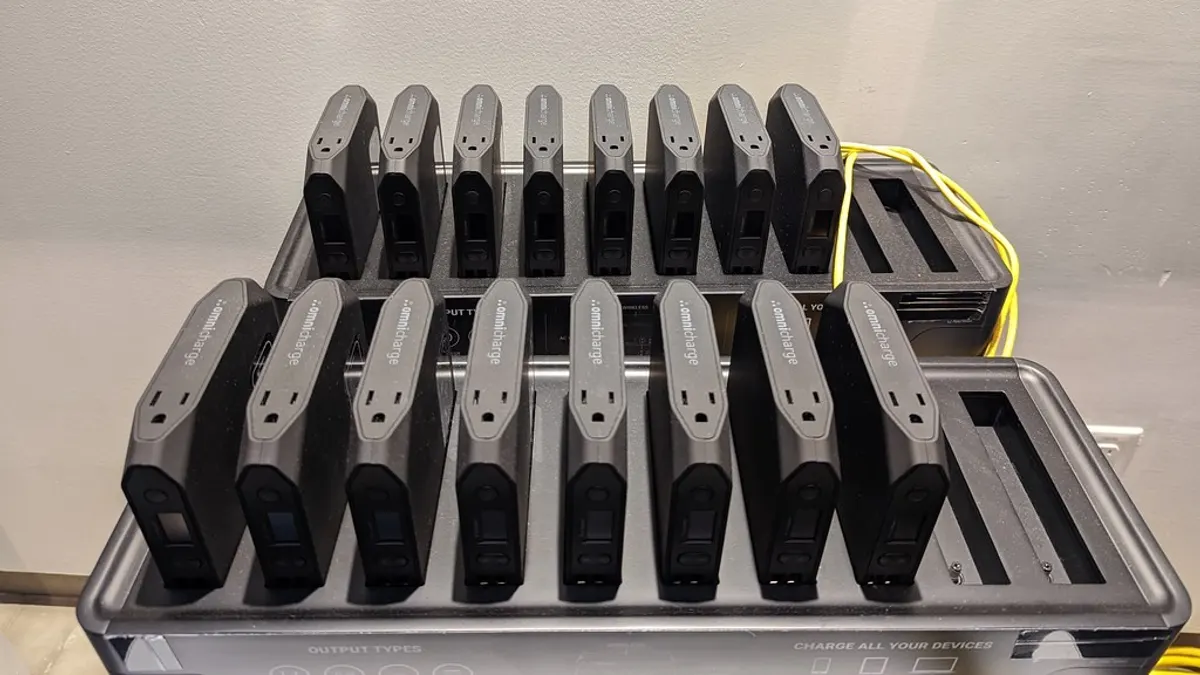
Cover photo: Loaner battery packs in rack, Northeastern Universtiy, Boston, Massachusetts by gruntzooki, CC BY-SA 2.0, via Flickr. Cropped.
Related guides
Electric Unicycle Maintenance Checklist: What to Check and When
Pre-ride checks, weekly tire pressure, monthly charging in storage and no pressure washing. A maintenance schedule built from InMotion and King Song.

Electric Unicycle Tire Guide: Sizes, Pressure, Tubes and Tubeless
Run your maker's pressure and check it weekly. Tire sizes on current wheels, the pressures makers give, and when tubeless or knobby tires make sense.

Electric Unicycle Winter Riding and Battery Storage Guide
Expect 20 to 40% less range, never charge a cold battery, and store the wheel at the charge level your manual gives. Figures from InMotion and King Song.