
Electric Unicycle Battery Safety: UL 2272, Charging and Storage
Affiliate disclosure: product links on this page go to Amazon, or to the maker's own store for brands that sell only direct. As an Amazon Associate we earn from qualifying purchases, at no extra cost to you; a link to a maker's store earns us nothing. No retailer or brand sees our picks before they are published or has any say in them. How we choose.
UL 2272 is the US safety standard for the electrical system of personal e-mobility devices, and electric unicycles are inside its scope. A wheel certified to it has had its battery, charging and electrical system evaluated by an accredited lab for fire and electric shock hazards; the standard says nothing about how the wheel rides. Buy a wheel whose maker states UL 2272 certification, charge it only with its own charger on a hard surface away from exits, never overnight or unattended, and follow the storage rules in your wheel's manual.
What UL 2272 covers, and what it does not
UL 2272's full name is the Standard for Safety for Electrical Systems for Personal E-Mobility Devices. The current edition, UL 2272-24, covers e-scooters, self-balancing scooters, e-skateboards, electric unicycles and hybrids of these, according to the Consumer Product Safety Commission's June 2026 proposed rule. UL Solutions says it "was designed to reduce the serious risk of dangerous fires in these products," and devices evaluated to it are certified under UL product category FKIS.
| Described as part of UL 2272 | Outside an electrical standard |
|---|---|
| The battery pack and battery management system, including charging behavior | How the wheel balances, brakes or cuts out |
| Drop: the device is dropped three times from about one meter and must not explode, catch fire, rupture its battery, leak electrolyte or create a shock hazard | Top speed, tiltback settings and motor power |
| Vibration, with the whole device mounted on the vibration table | The rider's protective gear |
| Tamper resistance of the battery enclosure | Where it is legal to ride |
| Warning markings, such as "Store Indoors When Not In Use" on plastic enclosures not evaluated for sun and rain | Battery life and range |
The drop test details come from UL Standards and Engagement; the vibration, enclosure and marking details from the CPSC's review of UL 2272-24. The CPSC describes UL 2272-24 as addressing electrical hazards, so treat it as a fire and shock certification, not a riding safety rating.
"Tested to" is not "certified"
UL Solutions puts it plainly: "Tested to a standard is not compliance or certification." Certification can be issued only by an ISO/IEC 17065 accredited certification body or an OSHA Nationally Recognized Testing Laboratory. A listing that says a wheel was "tested to UL 2272" or "meets UL 2272" without naming the lab that certified it is not the same claim.
To check a wheel:
- Look for the certifying lab's mark on the wheel, its battery or its packaging. New York City's Local Law 39 requires that mark, logo or lab name on the packaging, documents or device for wheels sold there.
- Check the maker's product page. King Song, for example, states that its 14D Pro is "UL 2272 certified for electrical and fire safety."
- Search the lab's directory. UL Solutions lists certified products in its free Product iQ tool, where UL 2272 devices sit under category FKIS.
The federal rule in progress
UL 2272 is a voluntary standard nationally. On June 24, 2026, the CPSC published a notice of proposed rulemaking that would make the electrical systems of micromobility products, explicitly including eUnicycles, comply with UL 2272-24 (and UL 2849 for e-bikes, UL 2271 for loose battery packs) with added requirements. Comments closed August 24, 2026; the rule is not final, and as proposed it would apply to products made 180 days after a final rule is published.
| CPSC finding or proposal | Detail |
|---|---|
| Incidents | 227 fire, explosion, burn, overheating and smoke incidents from 2019 through 2023 across micromobility products, with 39 deaths and 181 injuries |
| Certification marks in stores | A 2023 survey found an accredited lab mark on 17 of 19 non-e-bike products and 10 of 93 e-bikes; weighted compliance across all types was about 45 percent |
| Tamper-resistant battery enclosure | Remove the UL 2272-24 exception that lets a tamper-evident seal stand in for a tamper-resistant enclosure |
| Incompatible chargers | Add a reverse polarity test to all three standards |
| Warnings | Add warnings about letting the product cool before charging, about homemade batteries and about unsafe charging |
| Market size | About 182,900 e-skateboards and eUnicycles sold in the US in 2024, by CPSC staff estimate |
Charging: what the fire authorities and makers say
These rules come from the FDNY, NYC DOT, UL Standards and Engagement and InMotion's V10 manual. They overlap almost entirely:
| Rule | Who says it |
|---|---|
| Use the charger that came with the wheel or one the maker recommends; no aftermarket or generic batteries or chargers | FDNY, NYC DOT, ULSE |
| Plug directly into a wall outlet, never a power strip | FDNY |
| Do not charge overnight or leave it unattended while charging | FDNY, NYC DOT, ULSE |
| Never block your way in or out of a room; do not charge near an exit | FDNY, NYC DOT, ULSE |
| Not on a bed, couch or under a pillow; away from anything flammable and from heat sources | FDNY |
| Charge at room temperature; InMotion says do not charge below 0°C (32°F) and charge in a warm place, 10 to 35°C (50 to 95°F) | FDNY, InMotion V10 manual |
| Make sure the outlet is dry and fault-free, and keep the wheel away from combustibles while charging | InMotion V10 manual |
The CPSC says it is already aware of micromobility products that carry a cool-down warning. If your wheel is hot after a long climb, let it sit before you plug it in. Our charging time calculator helps you plan a charge you can supervise from start to finish.
Storage
Makers differ on the storage charge level, so follow your own wheel's manual. InMotion's V10 manual says to store the wheel in a dry room, fully charge it before storage and charge it at least once a month, and it suggests a storage temperature between -10°C and 35°C (14°F and 95°F); below -20°C (-4°F) the battery locks itself and cannot be charged or used. King Song's winter guide says to keep the battery at around 50% if stored for long periods, in a dry, warm place. Both agree on indoor, dry storage away from heat. Our winter riding and storage guide covers cold-weather range and charging in more detail.
Warning signs and what to do
NYC DOT and the FDNY give the same signs: if a battery overheats, or you notice an odor, a change in shape or color, leaking or odd noises, stop using it immediately and, if it is safe to do so, move it away from anything that can catch fire. InMotion's manual adds smoke and visible damage, and says never to open or disassemble the battery yourself. UL Standards and Engagement warns that a damaged battery is at greater risk of thermal runaway, which can start hours or even days after the damage.
If it catches fire, leave the area, close the door and call 911. The FDNY warns that fire extinguishers do not work on lithium-ion battery fires and that batteries can reignite minutes, hours or even days after the visible fire is out. Never put a lithium-ion battery in household trash or recycling; in New York City that is illegal, and the FDNY directs residents to battery recycling centers.
Checklist
- Buy a wheel whose maker states UL 2272 certification, with a lab mark you can find.
- Keep the original charger; replace it only with the maker's part.
- Charge in a room you are in, on a hard floor, away from the door, not overnight.
- Let a hot wheel cool before charging, and never charge below freezing.
- Store indoors and dry, at the charge level your manual specifies.
- After a crash, check the shell and battery area for damage, swelling or smell before charging.
Some cities tie sales rules to certification; see our guide to where EUCs are legal. If you are buying second hand, use our used EUC checklist to check the battery and charger, and where to buy an electric unicycle explains how warranty and support differ by seller. For what pack voltage means, read battery voltage explained.
Frequently asked questions
What is UL 2272 certification on an electric unicycle?
UL 2272 is the Standard for Safety for Electrical Systems for Personal E-Mobility Devices, and its current edition covers electric unicycles. Certification means an accredited lab evaluated the wheel's battery, charging and electrical system for fire and shock hazards. It does not rate how the wheel rides, brakes or cuts out.
Is UL 2272 certification required for electric unicycles?
Not nationally yet. The CPSC proposed a rule on June 24, 2026 that would require UL 2272-24 with added requirements for micromobility products including eUnicycles, but it is not final. New York City already requires devices sold, leased or rented there to be certified, under Local Law 39 of 2023.
How do I know if my electric unicycle is really UL 2272 certified?
Look for the certifying lab's mark on the wheel, battery or packaging, check the maker's product page, and search the lab's directory; UL Solutions lists certified devices in Product iQ under category FKIS. UL Solutions notes that tested to a standard is not the same as certified.
Can I charge my electric unicycle overnight?
The FDNY, NYC DOT and UL Standards and Engagement all say not to charge overnight or leave a micromobility battery charging unattended. Charge while you are awake and nearby, on a hard surface, plugged straight into a wall outlet.
Should I store my EUC fully charged or half charged?
Makers disagree, so follow your wheel's manual. InMotion's V10 manual says to fully charge before storage and recharge at least monthly, while King Song's winter guide says to keep the battery around 50% for long storage. Both say to store indoors in a dry place.
What should I do if my electric unicycle battery smells or swells?
Stop using it at once and, if safe, move it away from anything that can burn, as the FDNY and NYC DOT advise. Do not charge it or open it. If it catches fire, leave, close the door and call 911, because fire extinguishers do not work on lithium-ion battery fires.
Sources
- Safety Standard for Lithium-Ion Batteries Used in Micromobility Products and Electrical Systems of Micromobility Products Containing Such Batteries (proposed rule, June 24, 2026), U.S. Consumer Product Safety Commission, Federal Register
- E-Bike/Micromobility Device Safety: Product Certification, UL Solutions
- E-mobility Devices, UL Standards & Engagement
- Dangers of Lithium-Ion Batteries, FDNY
- Electric Bicycles & More, NYC Department of Transportation
- City Reminds Retailers and Consumers to Only Purchase Certified Lithium-Ion Batteries and Devices, NYC Department of Consumer and Worker Protection
- INMOTION SCV V10 User Manual, INMOTION
- How to Maintain Your Electric Unicycle in Winter: Tips for Maintenance and Safe Riding, KingSong
- KingSong 14D Pro Electric Unicycle, KingSong
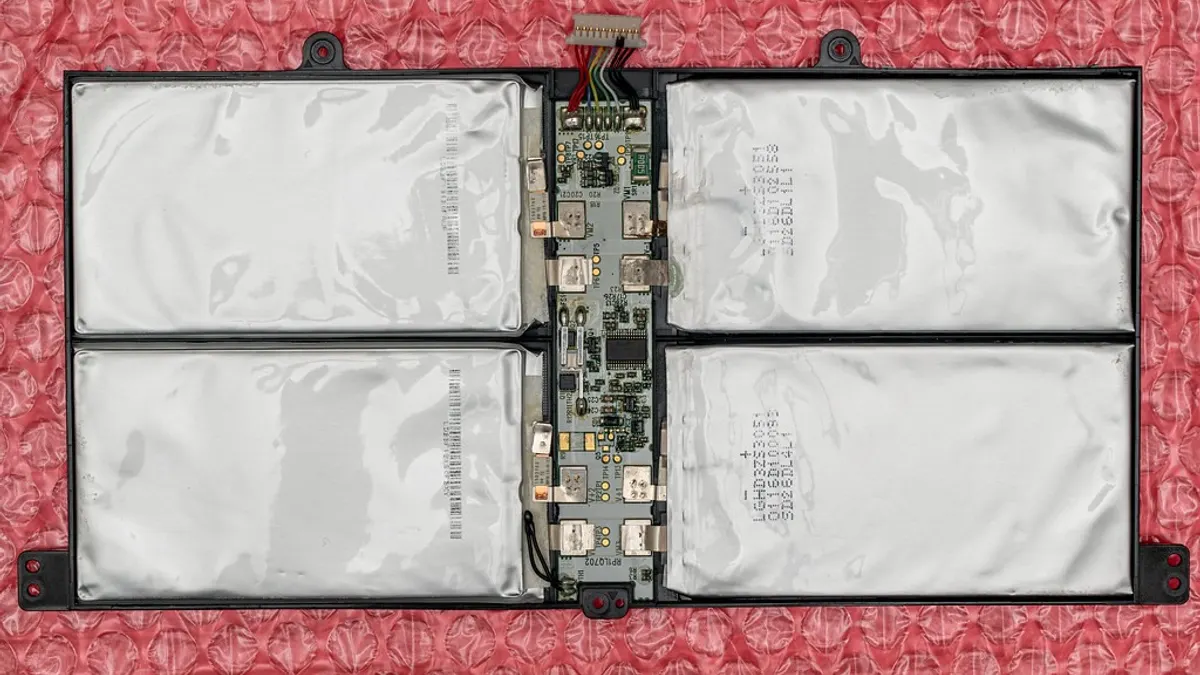
Cover photo: Failed Battery Pack by Razor512, CC BY 2.0, via Flickr. Cropped.
Related guides
Are Electric Unicycles Street Legal? What State Laws Say (2026)
Mostly, the law does not say. Washington and Arizona define one-wheel devices; five other states we read leave EUCs between categories.

Electric Unicycle Cutouts and Tiltback Explained
Tiltback is a warning; a cutout is the wheel running out of headroom. What each alarm means, from the makers' own manuals, and how to keep a margin.
Electric Unicycle Laws by State (2026): All 50 States and DC
A state-by-state table of where electric unicycles fit in the law, read from each statute: the seven that cover them, their speed and weight limits, and where you may ride.